

If you’re a male co-founder you know exactly what I’m talking about. In the three ad agencies I helped found and all of the startup clients we worked for, it was the very small exception, that co-founders actually assertively communicated their needs to each other. Had the hard conversations. I see the same working with co-founders today. From the outside, it makes no sense. These guys are often aggressive in business, highly confident, wildly smart and talented, and seemingly unafraid of anything - yet when it comes to a hard and real conversation with their co-founder - nope. Best I can do is go unresponsive and not come to the office for months. Best I can do is smash my computer out of passive aggression. Best I can do is let it all hang out to dry indirectly during client meetings vs. directly addressing it with you. Best I can do is lean on a junior employee well versed in mediation to smooth out our differences with short-term fixes vs. addressing the real elephants in the room like adults.

Why is that? Well, for starters, I’m going to cite a wild statistic that may surprise absolutely nobody: in heterosexual romantic relationships, women bring up relationship problems 80% of the time. Men typically avoid them like the plague. What’s more, in heterosexual relationships, men represent 85% of stonewallers. This essentially means that during conflict, they shut down physiologically (either voluntarily or involuntarily) and do not talk. This of course crosses over to the co-founder business relationships. And from the outside it’s obvious, avoiding the hard conversations will not resolve them - it will make what’s underneath them fester and calcify.
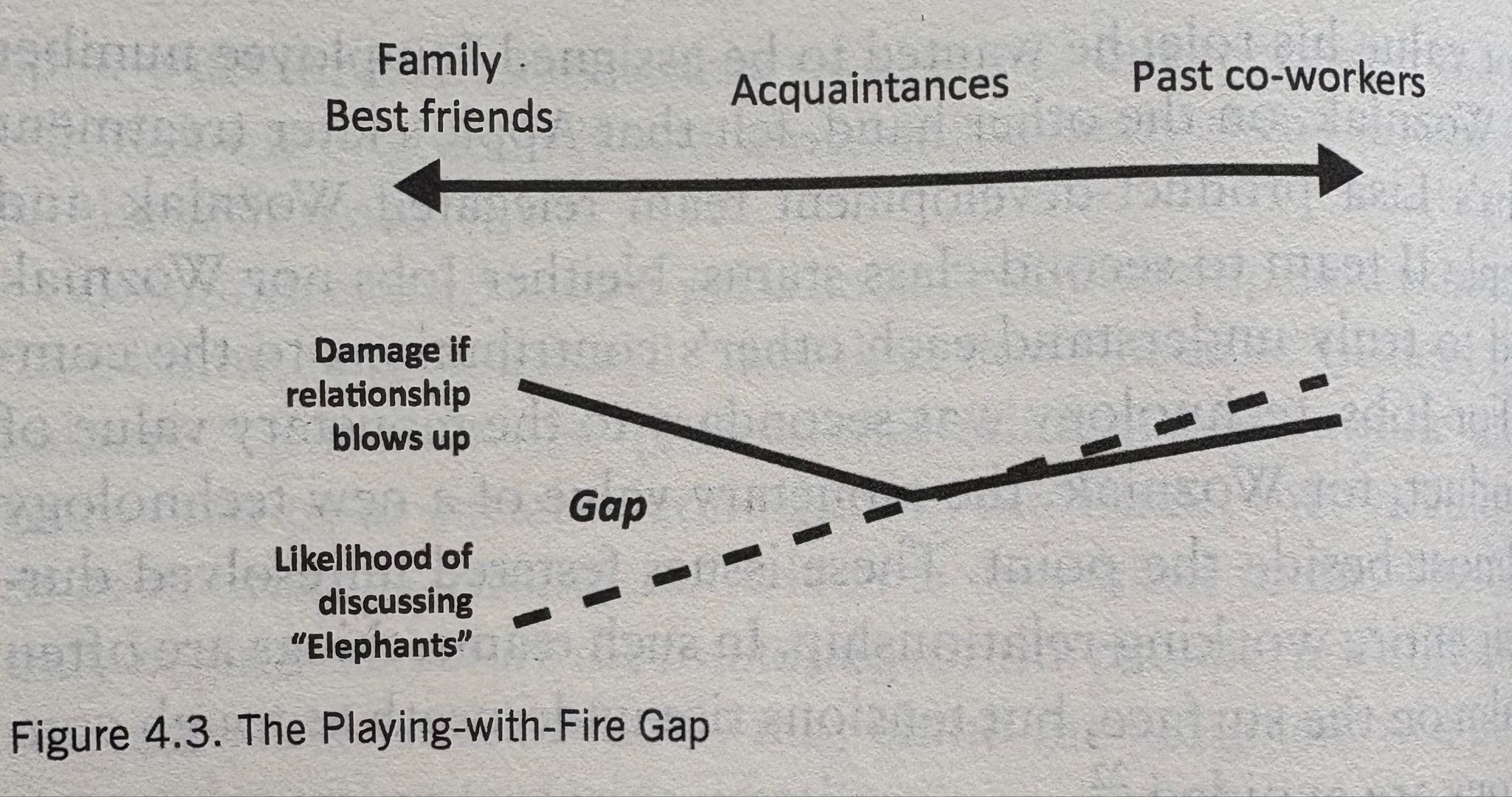
Noam Wasserman in The Founders Dilemma talks about the “Playing-With-Fire-Gap” for founding companies with friends and family. The closer the relationship, the more likely you’re going to protect the relationship over the business. Meaning you’ll avoid the hard conversations and the brutal honesty that could save the business in order to “protect” your relationship. I see this with 100% of my clients who have founded with friends or family. This is not me today, but it certainly used to be. And here’s why: I had no idea how to have hard conversations with people I was very close to. The stakes felt much higher, and attachment science validates this. With clients I could do it all day. Negotiate a deal, no problem. Because I could detach from emotion and lean into logic, persuasion, or aggression. But the closer it got, I felt wildly incompetent. Suffice to say, if you’re weighing starting a business with family + friends, either don’t do it OR start getting very good at assertive communication. And maybe hire someone like me pre-emptively. 🙂
Zooming out, societally men are socialized to avoid vulnerability and emotions from a very young age. It’s man code. So the very thing that can save your company is the very thing that you’ve been programmed to be bad at, which is also leading to co-founders experiencing higher rates of loneliness than the population at large. Vulnerability and emotions are the very things that make relationships not only functional, but also vibrant, alive, and magnetic. Read: sustainable. Read: successful. Yes, you need relational skills in order to make your co-founder relationship not just work, but thrive. And if you’re a man, you unfortunately have a higher learning curve.
So what do these skills look like?
First, you need a basic awareness of your primary achilles heels. What makes you difficult in relationships?
Do you always want to be right and choose this over openness + curiosity? Do you avoid and shut down during conflict? Do you like control and can you be overly critical with yourself and others? Does your competitiveness sometimes lead to you asserting your dominance and making those close to you feel small, either explicitly or implicitly?
You need a basic understanding of your emotions and how they manifest.
Anger, shame, sadness, fear, guilt. These are the challenging emotions that come up routinely for people, whether you know it or not. They are likely playing a bigger role than you’re conscious of. Anger is associated with fairness/justice, indicating when a boundary is needed. Shame/embarrassment is associated with feeling small/incompetent/weak/dumb or ostracized. Sadness is associated with loss or aloneness, indicating something needs to be let go of. Fear is by far the most common in startups, it’s everywhere, mostly manifesting as avoidance. And guilt is typically what’s blocking healthy expressions of anger (e.g. assertiveness).
You need to know when you are making up stories and projecting them onto your business partner
“They are not coming into the office because they don’t care.” “They are not as hard working as me and I’ll be carrying things forever.” “They are on their way out and pursuing other opportunities.” “They purposely trying to make me look bad in meetings.” Some of these things may be true, or partly true, and they could also be completely untrue. You won’t know unless a.) you’re aware that you make up stories that *could* be more about you and your history than about them and b.) you’re able to tactfully bring them up to check your mental math.
Need to learn how to regulate your emotions under stress
Do you know when you’re maybe going to lose it? When it might be best to take a time out, breathe, grab a bite, go to the gym, use a cold compress. What tools do you have to reliably regulate your emotions?
Learn how to communicate assertively, not aggressively, passively, or passive aggressively
In order to communicate assertively, you need to clearly understand what your underlying emotions are, what stories you’re making up, and what you ultimately need or want to go differently moving forward. You also need to do this from a regulated and calm place. And you want to keep a win-win in mind. Hence all the former steps.
Learn how to set boundaries
A clear sign that a boundary is needed is if you or your partner are constantly complaining about something re: your business partner, resentment is building, etc. That requires a clearing conversation. It’s kind of like negotiating/deal making. “Hey I can’t control you, nor do I want to, but if this continues to happen, this is what I’m going to do.” You make the implicit, explicit. Because you’re likely already pulling away or letting your anger out sideways.
You need to know how to repair after disagreement
Accountability, apology, validation, action. These are the steps to do a proper and thorough repair. Each takes work to learn. Here’s a step by step guide.
*Each of the above is a very basic introduction, not at all exhaustive.
If this sounds like a way too much to learn, or feels totally irrelevant or “soft” for you, I get it. I was once in your shoes. I resisted them too, and mainly because they felt so foreign and I hated being “bad” at anything. But in the end they’re like anything else, the more you practice the better you get. And learning even one of these tools well has the potential to grant you immense relief. Learning all of them well - well that makes you a master. Relationally a pro.
With gratitude,
Patch